3D Scanning & Reverse Engineering: A Practical Guide for Engineers
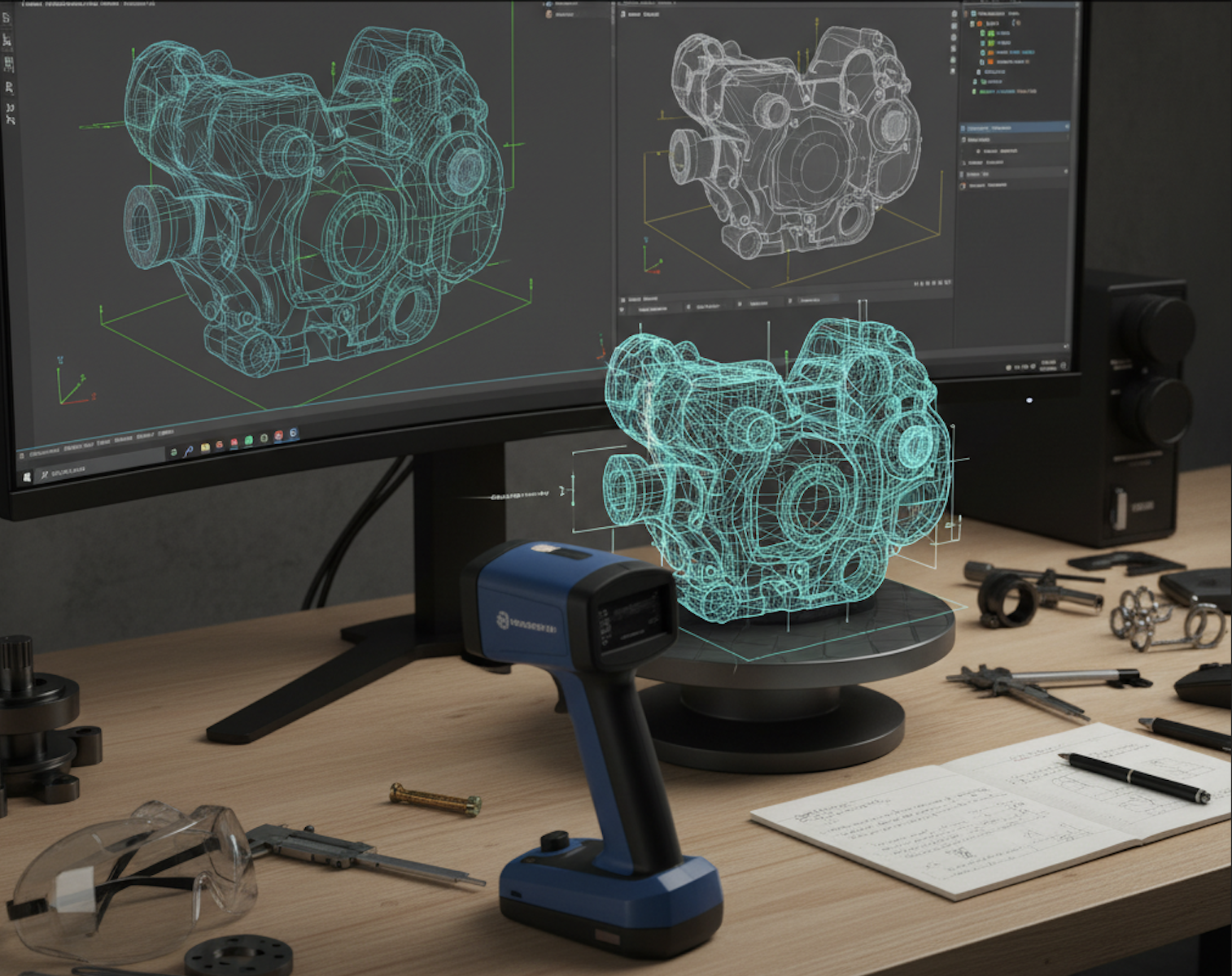
Reverse engineering is one of those disciplines that sounds more exotic than it is. At its core, it simply means taking a physical object and creating a digital model from it, rather than the other way around. 3D scanning is the technology that makes this practical. This guide explains how it works, when to use it, and what to expect from a professional 3D scanning service.
What is 3D scanning?
A 3D scanner captures the surface geometry of a physical object and converts it into a digital point cloud, a dense collection of XYZ coordinates that describe the object's shape. That raw data is then processed into a mesh (usually STL or OBJ format) or a parametric CAD model (STEP or IGES), depending on the intended use.
Modern professional scanners use one of two main technologies:
- Structured light scanning: projects a pattern of light onto the object and uses cameras to calculate 3D geometry from the distortion of that pattern. Fast and highly accurate, typically achieving ±0.05 mm.
- Laser scanning: sweeps a laser line across the object and triangulates position from the reflected beam. Good for larger objects and darker surfaces.
For most engineering applications, structured light scanning is preferred due to its accuracy and speed.
When does 3D scanning make sense?
Legacy parts with no surviving drawings
This is the most common use case. A component was made 20, 30, or 50 years ago and the original drawings or CAD files are lost. Rather than measuring by hand (which is slow and error-prone for complex shapes), a 3D scan captures the geometry accurately in minutes.
Reproduction of organic or hand-formed shapes
Machined and injection-moulded parts have clean geometry that can theoretically be measured with calipers. But organic shapes (sculpted forms, ergonomic handles, complex surfaces) are essentially impossible to recreate from manual measurement. Scanning captures them exactly.
Quality inspection
A 3D scan of a manufactured part can be compared directly against its CAD model to produce a colour deviation map, highlighting where the physical part differs from specification. This is useful for incoming inspection, tooling validation, and first-article reports.
Design modification from a physical original
Sometimes you need to modify an existing product you don't have CAD files for. Scanning creates the starting point: a digital model you can then edit in CAD software to add features, change dimensions, or design mating components.
Mould and tooling capture
Worn or modified tooling can be scanned to create an accurate record of its current geometry, useful for toolmakers quoting repairs or for archiving tooling state.
What does the process look like?
A typical reverse engineering project with us in Leeds follows these steps:
- Part receipt: you ship or bring the part to our Leeds workshop
- Scanning: we capture multiple scans from different angles to cover all surfaces
- Data processing: scans are aligned and merged into a single, clean mesh
- Output: we deliver in your required format, whether STL for 3D printing, STEP for CAD editing, or a deviation report for inspection
Lead time for most single parts is one to two working days. Complex assemblies or parts requiring full parametric CAD reconstruction take three to five days.
What file format do you need?
The right output depends on what you're doing next:
- STL: use this if you're going straight to 3D printing or CNC machining from the scan. It's a mesh, not parametric, so editing is limited.
- STEP / IGES: use this if you need to edit the geometry in CAD software. We reconstruct parametric surfaces from the scan data, which takes more time but gives you a fully editable model.
- Point cloud (OBJ / PLY): raw scan data, useful if you have your own processing pipeline.
- Deviation report (PDF): colour map comparing scan to CAD, used for inspection.
Accuracy expectations
Our structured-light scanners achieve accuracy of ±0.05 mm on standard engineering surfaces. Final accuracy depends on:
- Part size: larger parts require more scan positions and stitching, which can introduce small cumulative errors
- Surface finish: shiny metallic or transparent surfaces reflect or refract the scanner's light pattern, reducing accuracy. We apply a temporary matt spray to these surfaces before scanning
- Complexity: deep undercuts and internal features may require additional scan setups
For most prototyping and reproduction applications, the accuracy is more than sufficient. For tight-tolerance inspection work (bearings, precision bores, fine thread forms), a CMM remains the reference measurement tool.
Book a 3D scanning job in Leeds
If you have a part you need scanned and modelled, contact us with a photo and a description of what you need. We'll confirm lead time and pricing, usually within one working day.
Alternatively, if you're not sure whether scanning is the right approach for your project, our services page covers the full scope of what we offer and answers common questions.
We're based in Leeds, West Yorkshire, and accept parts by post or in person.