FDM vs SLA vs SLS: Choosing the Right 3D Printing Technology for Your Project
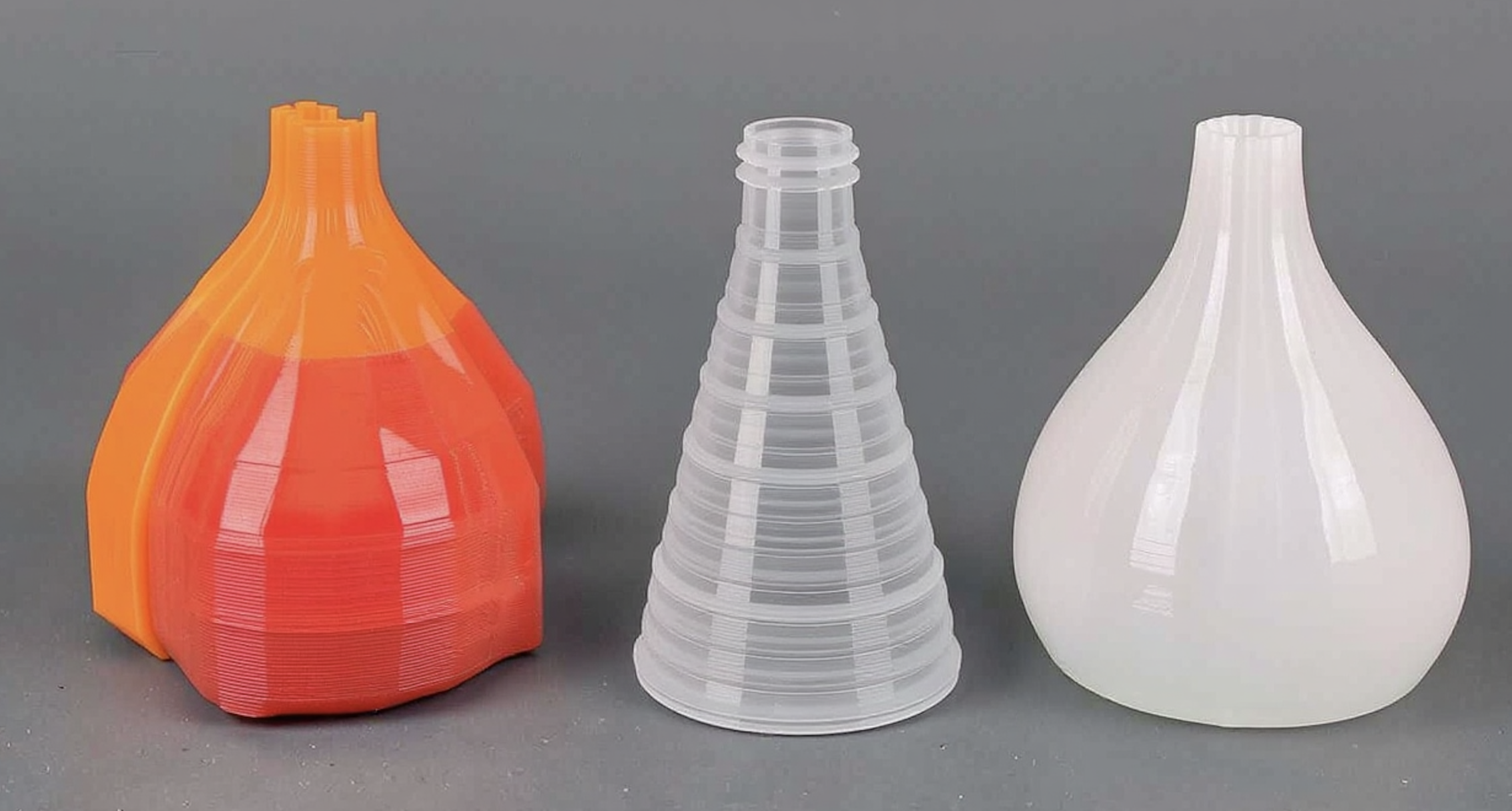
Choosing the wrong 3D printing technology is one of the most common and costly mistakes in prototyping. Order an FDM part when you needed SLA-level surface finish, and you'll be reprinting. Order SLS when FDM would have done the job, and you've spent three times what you needed to. This guide helps you match the technology to the requirement.
The three main technologies
FDM: Fused Deposition Modelling
FDM extrudes thermoplastic filament through a heated nozzle, depositing layers to build up a 3D object. It's the most widely available and cost-effective 3D printing process.
Best for: Functional prototypes, tooling and fixtures, structural housings, concept models where surface finish isn't critical
Materials: PLA, ABS, PETG, TPU, Nylon, Polycarbonate, Carbon Fibre composites
Strengths:
- Lowest cost per part
- Widest thermoplastic material selection
- Large build volumes available
- Same-day turnaround on most parts
- Mechanically strong in XY plane
Limitations:
- Visible layer lines on surface
- Anisotropic strength (weaker in Z direction)
- Not suitable for fine detail or smooth surfaces
- Support marks on overhangs
SLA: Stereolithography
SLA uses a UV laser to cure liquid photopolymer resin layer by layer. The result is parts with exceptionally smooth surfaces and fine feature resolution, the closest an additive process gets to an injection-moulded appearance.
Best for: Visual prototypes, presentation models, master patterns for silicone tooling, dental and medical models, jewellery casting patterns
Materials: Standard, Tough, Flexible, High-Temperature, Castable, Biocompatible resins
Strengths:
- Best surface finish of any 3D printing process
- Layer resolution down to 25 microns
- Excellent dimensional accuracy
- Isotropic mechanical properties
- Wide resin formulation options
Limitations:
- Higher cost than FDM
- Resins can be brittle vs engineering thermoplastics
- UV degradation over time (standard resins)
- Post-processing (wash + cure) adds time
- Smaller maximum build volume than FDM
SLS: Selective Laser Sintering
SLS uses a high-power laser to sinter nylon powder into solid parts. No support structures are required: the surrounding unsintered powder supports the part. This makes SLS uniquely capable of producing complex geometries, internal channels, and interlocking assemblies.
Best for: Functional end-use parts, mechanical components, snap-fits and living hinges, complex internal geometries, production-representative prototypes
Materials: Nylon 12, Nylon 11, Glass-filled Nylon, Carbon-filled Nylon
Strengths:
- No support structures: any geometry is printable
- Isotropic, production-grade nylon properties
- Excellent fatigue and chemical resistance
- Parts can be nested to maximise build efficiency
- Snap-fits and hinges work reliably
Limitations:
- Highest cost of the three processes
- Grainy surface texture (can be smoothed post-process)
- Longer lead times (2–4 days typical)
- Material selection limited to nylon grades
Quick decision framework
| Requirement | Best technology | |---|---| | Cheapest possible part | FDM | | Same-day turnaround | FDM or SLA | | Best surface finish | SLA | | Fine detail (< 1 mm features) | SLA | | Strongest mechanical part | SLS or FDM (engineering grade) | | No support structures needed | SLS | | Complex internal geometry | SLS | | Flexible rubber-like material | FDM (TPU) or SLA (flexible resin) | | Casting pattern for metal | SLA (castable resin) | | Production-representative nylon | SLS | | Large structural part | FDM |
Can I use more than one technology?
Yes. And for many projects you should. It's common to use FDM for early-stage form and fit checks (cheap and fast), then SLA for the aesthetic sign-off sample (smooth finish), then SLS for the final functional validation parts (production-representative properties). Each stage de-risks the design at the right cost point.
How to get a quote
Upload your STL file to our InstaQuote tool and you'll get instant pricing for FDM, SLA, and SLS side by side, so you can make the technology decision with real cost data in front of you. For complex projects or multi-part assemblies, contact our engineering team for a detailed recommendation.
We're based in Leeds, West Yorkshire, with fast UK delivery on all orders.