BMW ENET Gauge
Functional FDM printed housing and electronics design for BMW ENET Gauge
Project Overview
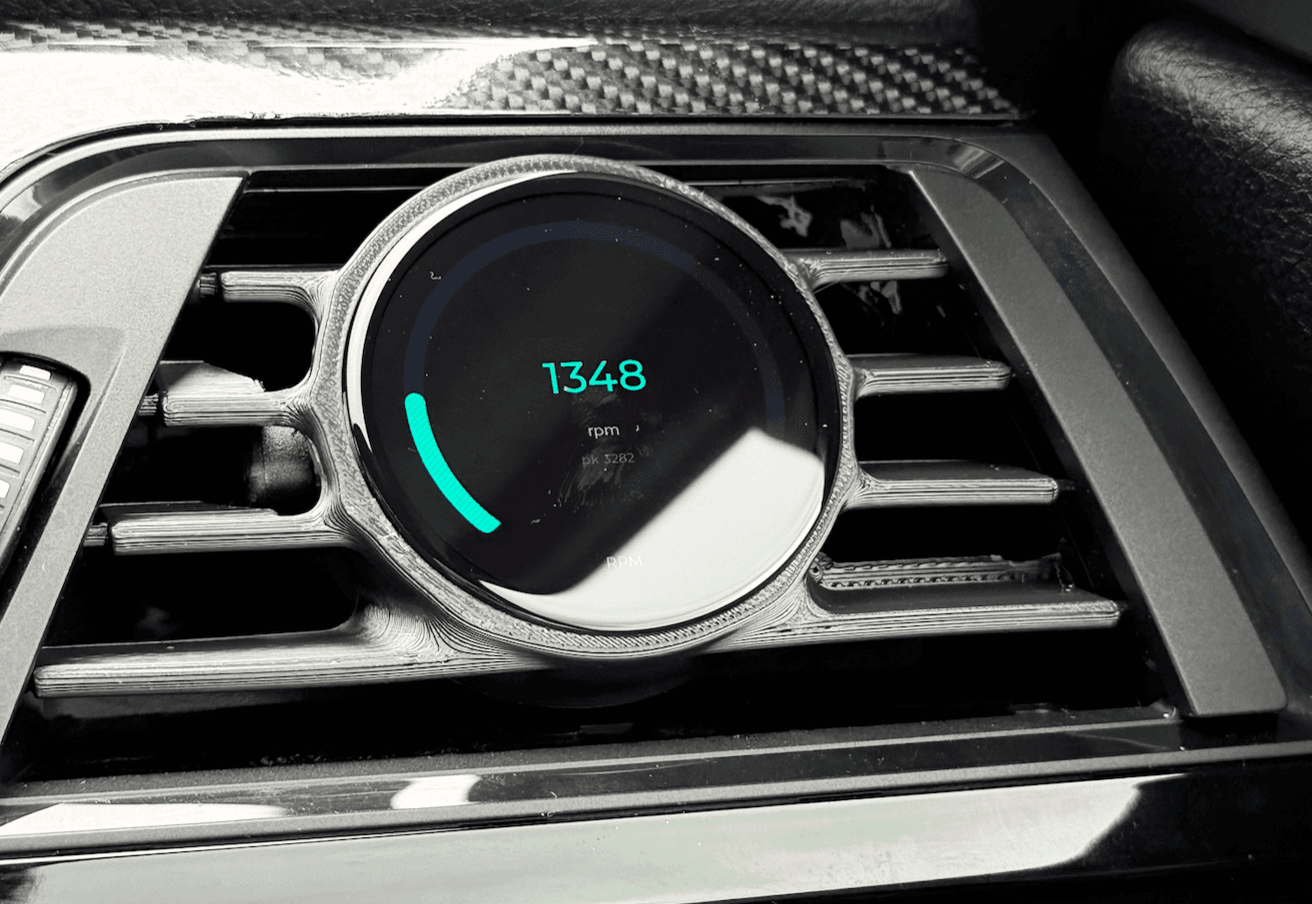
The BMW ENET Gauge is a live engine-data display that sits inside one of the car's own air vents and looks like it came from the factory. A 1.75" round AMOLED touchscreen, driven by an ESP32-S3 microcontroller.. It then shows one clear, glanceable gauge at a time.
Most aftermarket gauges mean drilling trim, sticking a pod to the A-pillar or running wires behind the dashboard. We wanted none of that. The goal was a gauge that drops into an existing vent opening, needs no permanent modification to the car, and comes out in seconds to return the interior to standard.
That left two problems to solve together. The housing had to match the vent's curved, irregular geometry exactly. The software had to turn raw diagnostic data into something a driver can read at a glance.
Key Requirements
- Zero modification: fits the existing vent with no drilling, cutting or adhesive, and is fully removable.
- Secure retention: holds the display firmly under road vibration with no rattles.
- Heat resistance: stays dimensionally stable in a car interior on a hot day, in direct sun.
- OEM appearance: matte black, with the display sitting cleanly within the vent bezel.
- Hidden power: the power cable is routed out of sight behind the vent.
- Wireless data: no extra wiring to the diagnostic port beyond the plug-in ENET adapter.
- Glanceable and trustworthy: readable at arm's length, in sunlight and at night. It must never show stale or corrupted data as if it were live.
- Multi-engine support: one firmware for several BMW engines, detected automatically.
3D Scanning the Vent
There is no published drawing of the vent, and its geometry is very hard to capture accurately with calipers. The bezel is curved, the throat tapers, and the internal ribs and clip features sit deep inside the opening. Instead, we 3D scanned the vent. Scanning it from several angles captured the face of the bezel, the depth of the opening and the internal features the insert would need to locate against.
Processing the Scan
A raw scan is a dense, noisy mesh, which can't be designed on directly. We processed it in stages:
- Clean up: removed stray points and scan noise, and filled holes where the scanner could not see.
- Align: set the mesh up in a sensible coordinate system, with the vent's axis as the reference, so the design could be built square to it.
- Simplify: reduced the mesh to a workable size without losing the detail that mattered.
- Extract reference geometry: traced the key features into CAD as sketches and surfaces, including the opening profile, the mating faces and the depth available behind the bezel.
The scan became a reference body to design against, not the final part. That keeps the insert accurate where it touches the car and clean, parametric geometry everywhere else.
Designing the Insert
The insert was designed around the display module. A pocket sized to the 1.75" round AMOLED board holds the screen square and centred in the vent opening. The outer profile follows the scanned opening with a tuned clearance, so the insert pushes in and holds securely without stressing the original trim.
Design for Additive Manufacturing (DfAM) decisions shaped the part throughout:
- Fit from the scan: every surface that touches the car comes from the scan data, so the insert locates on the vent's real geometry instead of an estimate.
- Retention without adhesive: the insert grips the vent mechanically. It stays put over bumps and comes out without leaving a mark.
- Cable routing: an internal channel carries the USB-C power cable back through the vent and out of sight.
- Print orientation: the part is oriented so the visible face gets the best surface finish and the critical fit features print accurately, with supports kept away from cosmetic surfaces.
- Iterative fit testing: test prints dialled in the clearances before the final part was printed.
Material and Printing
The insert is FDM printed in black ABS. On a hot day in direct sun, a car interior can climb past the softening point of PLA (around 60 °C). ABS has a glass transition temperature of around 100 °C, so the insert keeps its shape and its grip on the vent through summer heat. Black also matches the surrounding trim and frames the display's bezel so it disappears into the vent.
Software Design
The firmware was written from scratch for this gauge. At a high level:
- Connecting to the car: on power-up the gauge finds and joins the ENET adapter's WiFi network.
- Identifying the engine: the VIN tells the gauge which engine it is talking to. If a car isn't recognised, the gauge shows nothing rather than guessing and displaying wrong values.
- Reading live data: values are requested from the DME with standard diagnostic reads, several per request. Fast-changing channels such as boost and RPM are polled every cycle, and slow ones such as temperatures are rotated through in the background. Every scaling factor was checked against published DME documentation.
- Two cores, two jobs: the ESP32-S3 has two processor cores. One talks to the car and the other runs the display and touchscreen, so the gauge stays smooth even when the network is slow.
- Never trust bad data: corrupted or out-of-range readings are rejected instead of displayed. A frozen number looks just like a live one, so the gauge labels stale data explicitly. Critical values trigger a red alert banner and a pulsing arc.
- Designed for a round AMOLED: the interface uses the circular screen with a 270° arc and the value in large digits at the centre. Warning and critical zones are marked on the arc, and a peak-hold marker shows the highest value reached. True-black backgrounds, automatic dimming and periodic pixel shifting protect the AMOLED panel from burn-in.
- Built for driving: a deliberate press-and-hold changes gauge, so a bump in the road can't. Day, dusk and night brightness presets keep the screen readable without dazzling the driver.
- Tested: an automated test suite checks the data conversions, engine detection and alert thresholds on every change. In-car testing caught real problems that only show up on a live car, such as a cylinder 3 ignition-timing channel mapped to the wrong data identifier, and those fixes are now covered by tests.
Results
The finished gauge turns a standard air vent into a live engine-data display with no permanent changes to the car. The scanned-and-designed insert locates on the vent's real geometry, holds the display securely, hides the power cable, and comes out in seconds.
On the road, the gauge connects to the car automatically and identifies the engine from its VIN. Live data updates smoothly while the screen stays readable at a glance. In-car testing on an S55-powered BMW confirmed the live readings and drove several refinements to the data mapping, touch controls and display layout.
The project combines 3D scanning, Design for Additive Manufacturing and embedded software in one part. It shows how scan-based design can produce a precise, OEM-quality fit on complex automotive geometry where no drawing exists.